

Documentation Index
Fetch the complete documentation index at: https://berachain-422fce37-feat-fusaka.mintlify.app/llms.txt
Use this file to discover all available pages before exploring further.

Benefits
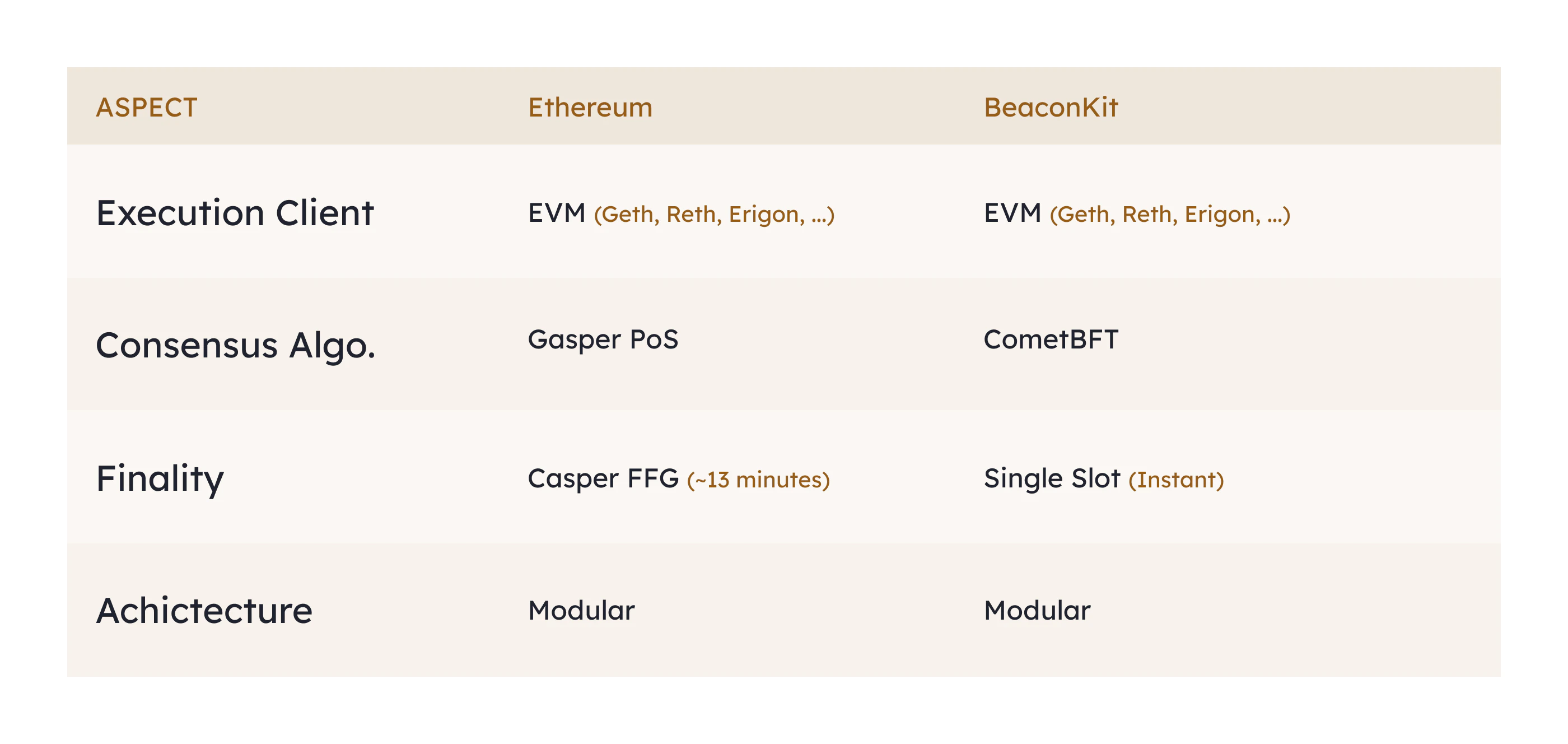
Some of the key benefits that come with BeaconKit:- Eth2 modularity - Adheres to separation of execution and consensus with communication via Engine API
- Promotes execution client diversity - Any EVM execution upgrades can be supported out of the box, avoiding the need to run and maintain a custom forked EVM execution client to work with the chain
- CometBFT - Leverages a trusted consensus algorithm
- Instant finality - Achieves Single Slot Finality / Instant Finality, compared to Ethereum’s finality of ~13 minutes
- Leverages EVM tooling - The majority of all EVM tooling is supported
- Modular - BeaconKit is also a modular framework that can allow for the potential implementation of a custom block builder, rollup, data availability layer, and more
Deposit processing
BeaconKit consumes deposits directly from the execution payload’s request list (EIP-6110), one block at a time. Each EL block that includes deposit transactions surfaces them as a customDeposit(bytes,bytes,uint64,bytes,uint64) event from the deposit contract; the CL parses that event into a 192-byte deposit request and applies it in the same block. There is no follow distance, no pre-fork queue, and no per-epoch processing window — once the EL block is finalized, the deposit is reflected in validator state.
The wire formats and parser are documented in the EIP-6110 deposits specification.
EVM inflation parameters
The CL chain spec carries the per-block inflation address and amount that the consensus layer mints to as a withdrawal each block. The Fulu fork introduces two new fields on the chain spec —EVMInflationAddressFulu and EVMInflationPerBlockFulu.